The AI-Optimized Mid-Day Performance Routine: Sustaining Energy on Autopilot

The mid-day slump—that inevitable brain fog and lethargy that hits around 2:00 PM—is not a sign of weakness; it is a biological reality dictated by your circadian rhythm and post-prandial (post-meal) metabolic shifts. Most professionals attempt to brute-force their way through this crash with excessive caffeine, which only destroys their sleep architecture later that night. In 2026, high performance requires a different approach: automated environmental adaptation.
By allowing your personal AI health assistant to take control of your workspace, you can seamlessly navigate the mid-day dip. Here is your protocol for sustaining peak cognitive output on autopilot.
Phase 1: The AI-Adaptive Ergonomic Shift
When your metabolic energy naturally dips, static sitting exacerbates lymphatic stagnation and fatigue. This is the exact moment your environment must force physical engagement.
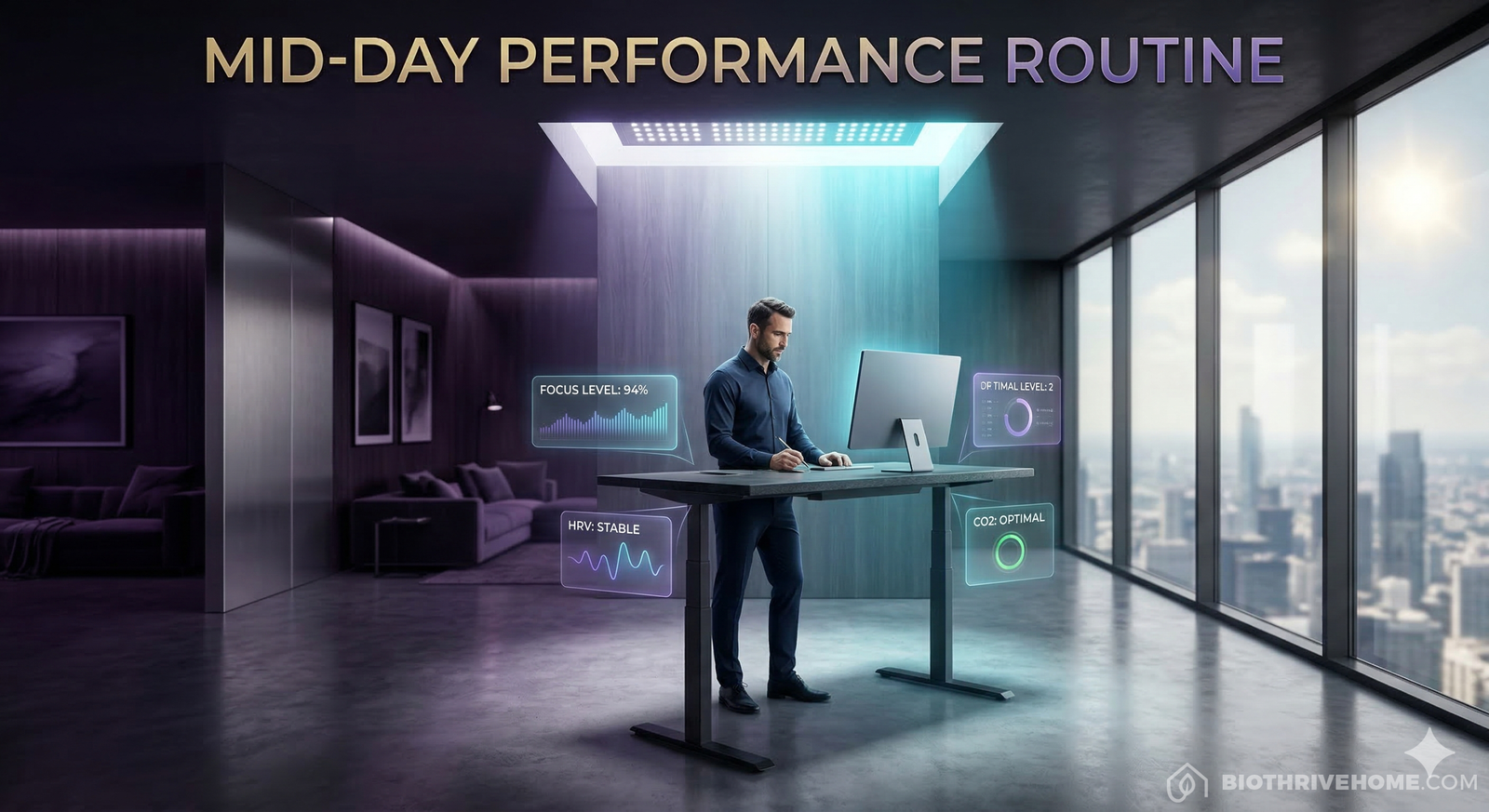
- The Automated Transition: As your wearable sensors detect a drop in your heart rate and a subtle rise in body temperature (typical after a mid-day meal), your AI-adaptive workspace takes action. Without you pressing a button, your smart desk slowly elevates to a standing position.
- Active Recovery Integration: Simultaneously, the subtle vibration platform beneath your feet activates. This low-frequency stimulation encourages blood flow back to the brain and prevents the pooling of fluids in the lower extremities, instantly combating physical lethargy without disrupting your workflow.
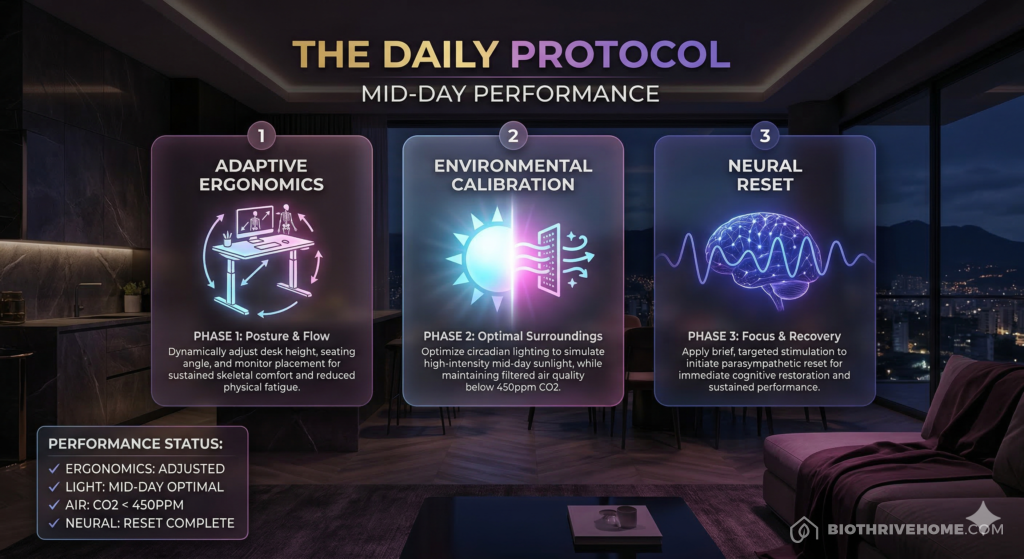
Phase 2: Environmental Focus Calibration
Your brain relies heavily on environmental cues to determine whether it should be alert or sleepy. You must manipulate the air and light to trick your biology into a second wind.
- Circadian Light Blasting: The warm, comfortable lighting of your morning must be eradicated. Your AI assistant shifts the lighting panels in your high-performance home office to a crisp, cool, blue-enriched white light (around 5500K to 6000K). This specific wavelength forcefully suppresses any mid-day melatonin production and sharpens visual acuity.
- Aggressive Air Exchange: Cognitive fatigue is often disguised as mild CO2 poisoning. Triggered by the mid-day schedule, your high-tech air quality monitors command your heavy-duty HEPA purifiers to perform a rapid air flush. Pumping the room full of filtered, oxygen-dense air eliminates the heavy, stale feeling that contributes to afternoon brain fog.
Phase 3: The Biometric Neural Reset
Even with perfect lighting and posture, continuous deep work accumulates neurological stress. If your heart rate variability (HRV) drops too low, focus becomes impossible.
- The Micro-Recovery Loop: If your biometric data indicates severe cognitive strain, the AI pauses your deep-work block. It dims the lights slightly and initiates a brief, 5-minute neural reset utilizing your vagus nerve stimulation protocols.
- Frictionless Return: Whether through a smart wearable emitting specific frequencies or a localized acoustic soundscape, this micro-break lowers your cortisol levels instantly. Once the 5 minutes are up, the lighting returns to peak focus mode, and you resume work in a state of flow rather than friction.
Conclusion: Engineering the Second Wind
You cannot out-work your biology, but you can automate your environment to support it. By syncing your desk mechanics, circadian lighting, and air quality with your real-time biometric data, the mid-day slump becomes obsolete. You maintain a steady, elite level of output from morning until evening, entirely on autopilot.