How to Build a Data-Driven Sleep Sanctuary in 2026 (A Step-by-Step Guide)

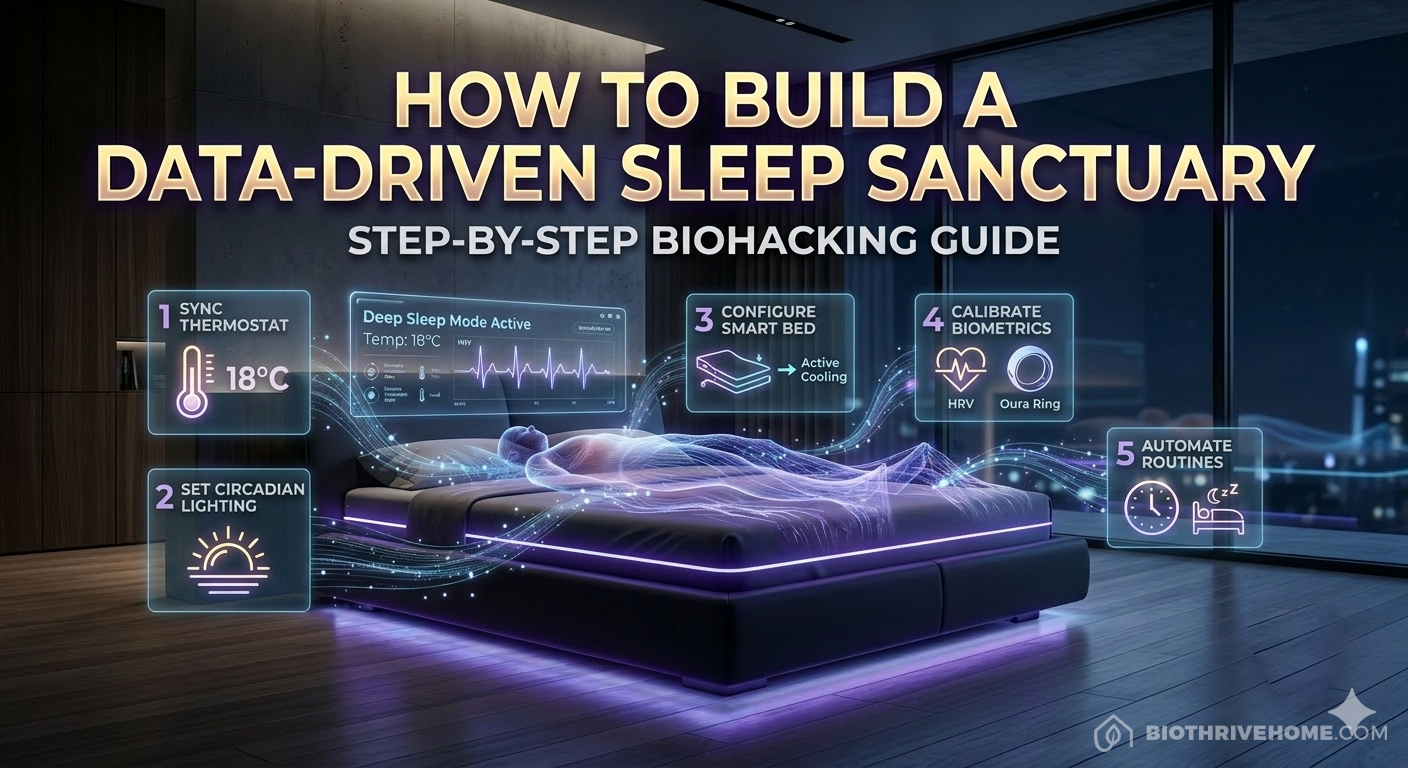
You have optimized your light, perfected your evening routine, and perhaps even upgraded your mattress. But if you are still waking up less than 100% recovered, the missing link is integration. You are collecting data, but your environment is not reacting to it. In 2026, the standard for optimal recovery is a “Sleep Sanctuary”—a fully automated, data-driven system that uses real-time biometrics to actively manage your environment.
Building this sanctuary isn’t complex, but it does require a specific, sequential approach. This is your definitive 5-step guide to automating your sleep.
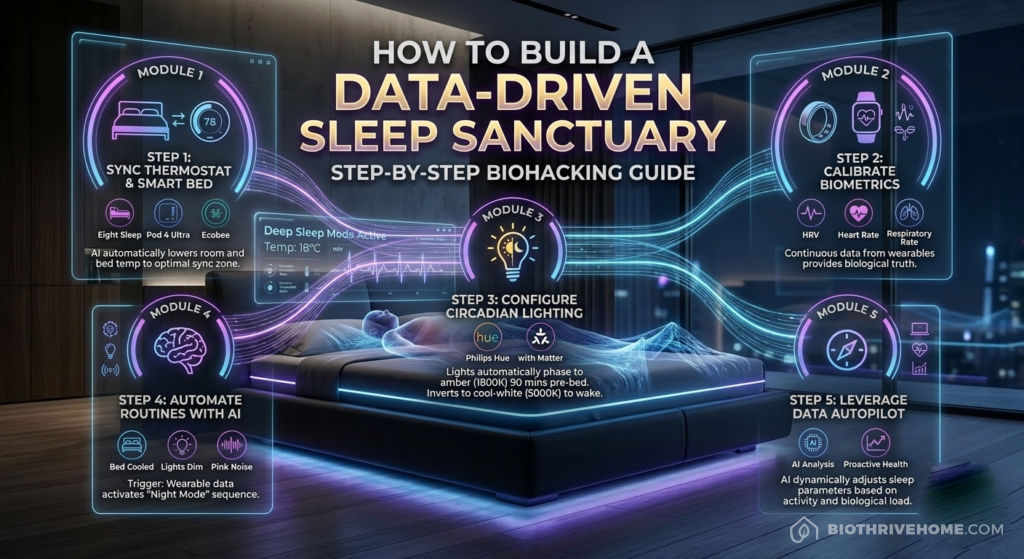
Step 1: Sync Your Thermostat and Smart Bed for Core Drop
The foundation of a data-driven sanctuary is active thermoregulation. Human biology requires a specific core body temperature drop to initiate deep sleep.
- How To: The core of your sanctuary should be an intelligent system like the Eight Sleep Pod 4 Ultra (which we reviewed for its medical-grade tracking). For maximum effect, link the smart bed’s “Autopilot” algorithm to your smart thermostat (like an Ecobee with Siri or Google Assistant). This allows the AI to not just cool the bed surface to 18°C (64°F) but also lower the ambient room temperature to a synchronized optimal setting (around 66°F-68°F) exactly when your sleep data indicates you are entering slow-wave sleep.
Step 2: Calibrate Your Biometrics and HRV
You cannot automate what you do not measure. A data-driven sanctuary requires a central source of biological truth.
- How To: While smart beds provide excellent data, a peripheral wearable that you also wear during the day, such as an Oura Ring or Apple Watch, is essential for a complete biometric picture. Your sanctuary’s central hub (whether an AI voice assistant or a dedicated tablet) must ingest your HRV, Heart Rate, and Respiratory Rate. This is the data that will drive every subsequent automation. For details on how to use this data, see The Science of Rest: Using AI for Sleep Optimization and Recovery.
Step 3: Configure Your Circadian Lighting System
Lighting is the primary driver of your circadian rhythm. You cannot achieve optimal hormonal balance without proper light management.
- How To: You must install a full-spectrum circadian lighting system, such as Philips Hue with Matter. Configure this system to a data-driven schedule. Your biometric wearables should notify the system 90 minutes before your ideal bedtime. At this trigger, the lights must automatically phase out all blue light, shifting to a very dim, warm amber (around 1800K) to signal melatonin production. In the morning, the system must reverse, using bright, cool-white light (5000K-6500K) to suppress melatonin and signal a rise in cortisol for an energetic wake-up. For a deep dive, read The Circadian Smart Home: Hacking Your Lighting for Optimal Hormonal Balance in 2026.
Step 4: Automate Your Routines with AI
A data-driven sanctuary goes beyond simple on/off switches; it uses context to create a non-negotiable routine.
- How To: Create an “Automation Chain” triggered by your biometric data. For example, when your smartwatch detects that your resting heart rate has dropped below a specific threshold (signaling you are truly wind-down ready), your AI assistant should automatically: 1) dim the circadian lights to 1% warm-amber, 2) set the smart bed to its precise cooling temperature, and 3) begin playing a biometric-driven pink noise soundscape, all without human input.
Step 5: Leverage Your Data for Autopilot Recovery
The final step is granting your AI absolute control over the previous four steps.
- How To: Your AI assistant must become the “autopilot” of your recovery. If your daily activity data shows an incredibly high physical load (tracked by systems like The Rested Edge: Top 3 AI-Powered Sleep Trackers of 2026 for Longevity), the AI should automatically adjust Step 1 to make the bed and room temperature slightly cooler for increased inflammation reduction, and adjust Step 4 to initiate the automation chain 15 minutes earlier than usual.
Conclusion: Absolute Control Over Recovery
By building a data-driven sleep sanctuary, you are moving beyond simple data tracking and entering the era of data activation. By synchronizing your biometrics, temperature, light, and routines, you remove the friction of behavior change and automate the precise environment your body needs for optimal healthspan.